
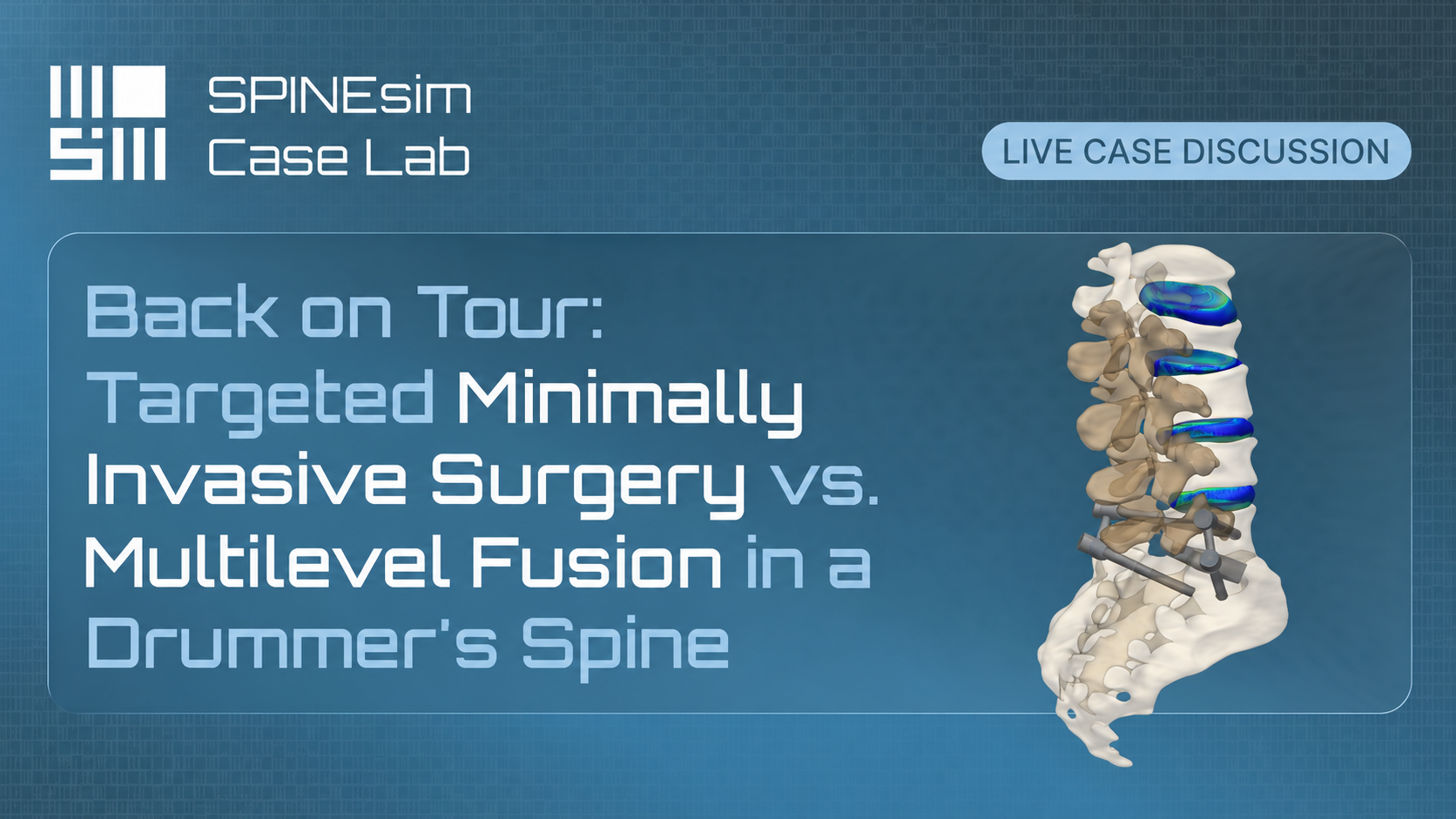
SPINEsim Case Lab Episode 3: Targeted Minimally Invasive Surgery vs. Multilevel Fusion in a Drummer’s Spine

SPINEsim Case Lab Episode 3: Targeted Minimally Invasive Surgery vs. Multilevel Fusion in a Drummer's Spine

In the third episode of SPINEsim CaseLab, we explore the case of an 81-year-old professional drummer who presented with years of neurogenic claudication and left plantarflexion weakness.

Imaging showed 25° degenerative lumbar scoliosis, retrolisthesis at L2/3, anterolisthesis at L3/4, central canal stenosis from L2 to L5, and severe left foraminal and lateral recess stenosis at L5/S1. EMG confirmed active denervation of the left L5/S1 root. His medical history included stroke, moderate aortic regurgitation and bladder cancer.

On imaging alone, many surgeons would consider a multilevel fusion. Instead, the fusion was limited to the one level that required it – an AR-guided left L5/S1 MIS-TLIF – and L2–L5 was decompressed through a minimally invasive ‘slalom’ unilateral laminotomy for bilateral decompression. He was traveling again within weeks and back on tour six weeks after surgery.

The session will discuss patient selection, identifying the true surgical target, and minimizing the footprint of surgery – and will use SPINEsim to compare the targeted approach with a multilevel fusion: load on the segments above the L5/S1 fusion, stability of the decompressed but unfused L2–L5 levels in a scoliotic spine, and the long-term mechanical risk of each strategy.

Leave a Reply

Your email address will not be published. Required fields are marked *